Guide: Permission to work and volunteering for asylum seekers
Share this article
The rules around work permission and volunteering for asylum seekers are complicated. If you want to apply for work permission, or you are supporting someone who wants to apply, it is important to understand the rules and processes. This Guide seeks to answer the most common questions and can be translated at the top right of the page.
Introduction: Work Permission for asylum seekers
Asylum seekers are generally not allowed to work. Asylum seekers are only allowed to work if:
- they have been waiting for 12+ months for a decision on their asylum claim (it is not possible to apply if you are appealing an asylum refusal); and
- they are aged over 18; and
- they are the main applicant on the asylum claim – dependent partners are not permitted to apply for work permission.
Asylum seekers who are granted work permission are limited to working in job roles on the Shortage Occupation List (if granted permission before 4th April 2024) or the Immigration Salary List (if granted permission on or after 4th April 2024).
Read: Home Office guidance on Permission to work and volunteering for asylum seekers.
How do I apply for permission to work?
If you qualify, work permission is not issued automatically. You must apply to the Home Office by completing Permission to Work form: PTW1 and sending it to Permission to Work Team [Level 0, Capital Building, Old Hall Street, Liverpool, L3 9PP].
Alternatively, you can email the completed Form to AsylumPTW@homeoffice.gov.uk (if you are waiting more than 12 months for your first asylum decision) or to FurthersubmissionsPTW@homeoffice.gov.uk (if you have made further submissions and are waiting more than 12 months).
We recommend that you ask your solicitor to do this for you. Your solicitor can tell you:
- if you qualify to apply for permission to work; and
- if there is any reason why you should not apply.
Alternatively, an IAA Level 1 Adviser can assist you. Find an IAA adviser here.
Who is eligible to be granted permission to work?
The Home Office will only grant permission to work if:
- you are aged 18+ years; and
- you are the main asylum applicant; and
- you have waited for 12+ months for a decision on an asylum claim; and
- you have not caused the delay (this means you have complied with all requests for information and attended all scheduled interviews)
Your application may be refused if you have a criminal record in the UK or any other country.
How do I know if I have been granted permission to work?
If your application is successful, you will receive:
- a letter from Home Office explaining that you have been granted work permission. This letter is important – it contains details about:
-
- the conditions of your work permission and any restrictions
- applying for a National Insurance Number
- proving your right to work
- how earning may impact your entitlement to receive asylum support
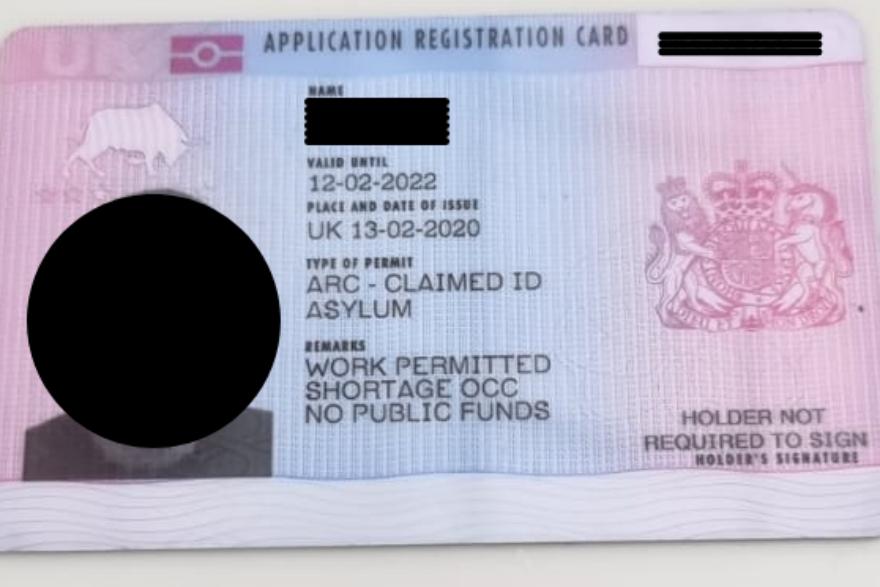
- an updated Asylum Registration Card (ARC) stating:
- WORK PERMITTED – you can now work.
- SHORTAGE OCC or PARA 360 – you can only do a job on the Shortage Occupation List or the Immigration Salary List.
- NO PUBLIC FUNDS – you cannot claim most social security benefits, or housing assistance from the government.
- a new Bail 201: You will have received a paper Bail 201 document from the Home Office when you first made your asylum claim. It contains your photograph and some personal details. Your new Bail 201 will say “your immigration bail is being varied” – this means there is a change in your bail conditions. Under “Conditions” it may say “You are allowed to WORK at: Shortage Occupation List (SOL), or Immigration Salary List (ISL)”
Restrictions
A grant of permission to work does not allow you to:
- find employment in jobs not on the Immigration Salary List/Shortage Occupation List.
- be self-employed (this includes delivery-type work)
- engage in any business or professional activity.
- apply for public funds (benefits) and pensions.
Read more.
Work Permission for asylum seekers with existing leave
If an individual has existing leave (permission) to be in the UK (e.g. as a student, skilled worker) and they apply for asylum before their current leave expires, and that leave allows them to work, they may continue working under the same conditions as their previous leave.
Section 3C of the Immigration Act 1971 automatically extends the leave of a person who applies for further leave to remain (such as asylum) before their current leave expires.
This extension includes the same conditions as their previous leave, including the right to work, until the asylum claim is finally determined.
Individuals should check that their Bail 201 (paper document) states that they have work permission, or confirm via their solicitor that they have retained the right to work.
Read more: Permission to work and volunteering for asylum seekers
What roles am I allowed to work in?
You must only work in a role that is on either the Shortage Occupation List, or the Immigration Salary List, depending on when you were granted work permission.
You and your employer must ensure that the job you plan to take is on the relevant occupation list. Each job has a 4-digit “occupation code”. If you do not know your job’s occupation code, you can search for your job in the CASCOT occupation coding tool.
If you are found to be working in a role that is not permitted, you will be considered to be an “illegal worker”. The Government treats illegal working very seriously.
The penalties for illegal working are:
- Up to 5 years in prison
- Unlimited fine
- Up to 6 months in prison
- Fine of up to £5,000
- Criminal record – having a criminal record can negatively impact future settlement applications e.g. Indefinite Leave to Remain.
It is the responsibility of both the employee and the employer to ensure they stay within the rules.
Shortage Occupation List or Immigration Salary List?
Until 4th April 2024, asylum seekers who were granted work permission were limited to working in jobs on the Shortage Occupation List. On 4th April 2024, the Government introduced the new Immigration Salary List.
- If granted before 4th April 2024 work permission applies to roles on the Shortage Occupation List only
- If granted on or after 4th April 2024 work permission applies to roles on the Immigration Salary List only
Shortage Occupation List: this list has now been “archived” – or shelved – but it still applies to those limited to SOL. An archive of the SOL can be accessed from page 820 here.
How can I prove my right to work?
Asylum seekers, unlike other migrants, are not able to get a Share Code to prove their right to work. Employers should consult the Employer’s guide to right to work checks to understand their responsibilities.
Potential employers must use the Government’s Employer Checking Service to confirm an employee’s right to work. Once you have given them permission to carry out the check, you should share details from your new Application Registration Card.
Once complete, your employer should receive a “Positive Verification Notice” (PVN) that is valid for 6 months.
‘Positive Verification Notice’ (PVN) is a positive confirmation of a person’s right to work from the Employer Checking Service. This will provide the employer with protection from prosecution for six months.
If you lose your right to work within those 6 months, you must stop working immediately, otherwise you may be prosecuted for working illegally. The PVN does not give you the right to work for 6 months. See section “How long will my work permission last?“.
The PVN outlines any restrictions (e.g. Shortage Occupation List only) and tells the employer that they must carry out another check before the PVN expires to confirm that the individual still has permission to work. It also contains web links to both the Shortage Occupation List and the Immigration Salary List.
Positive Verification Notice:
How long will my work permission last?
Your permission to work will come to an end if your asylum claim or fresh claim is refused and any appeal rights exhausted. If this is the case, the Home Office will write to you and tell you that your permission to work has been revoked. You will be asked to return your ARC to the Home Office and a new card will be issued to you. You will also receive a new Bail 201 with updated Conditions: “you are not allowed to WORK”.
What is a National Insurance Number?
Everyone who works in the UK aged 16 years+ must have a National Insurance Number. This number is unique to you and remains the same your whole life.
Your National Insurance Number makes sure that the financial contributions you make are properly recorded on your National Insurance account. You often need this number when communicating with government departments including in relation to social security and tax.
Your prospective employer will want to see your National Insurance Number. The Law Centre recommends that you apply for a National Insurance Number before you start work.
How do I apply for a National Insurance Number?
Once you have received your updated Asylum Registration Card (ARC), we recommend that you apply for a National Insurance Number. You can start the process online here. Enter your details exactly as they appear on your Application Registration Card.
It is likely that you will be asked to verify your ID by attending an appointment at a Jobs & Benefit Office. This appointment will be arranged by telephone so make sure you provide your correct phone number in your online application. You can ask for an interpreter for the appointment.
You will be offered an appointment to go to a Jobs & Benefits Office with your ARC to prove your identity.
You must not let anyone else use your National Insurance Number. This is fraud – committing fraud could result in criminal penalties and could negatively impact your asylum claim.
Income Tax
Income Tax is a tax you pay on your income. It is usually deducted from your pay before you receive it.
Most people pay Income Tax through PAYE. This is the system your employer uses to take Income Tax and National Insurance contributions before they pay your wages. Your tax code tells your employer how much to deduct.
You should receive a payslip from your employer regularly showing what deductions have been made.
If I start working, will my asylum support be affected?
Asylum support (accommodation and Aspen payments) are provided to asylum seekers who would otherwise be destitute i.e. unable to meet their essential needs.
When a person applies for asylum support, the Home Office takes into account any savings or resources available to the individual. This is part of an assessment called the “Destitution Test”. See section “The “Destitution Test – asylum support””.
Any earnings you receive from your employment may reduce or remove your entitlement to Home Office support.
If you are in receipt of asylum support, you must inform the Home Office immediately via Migrant Help if you start working so that a review of your entitlement can be carried out. Failure to notify the Home Office that you have started working can result in the withdrawal of your asylum support. Any changes to the level of asylum support you receive will be calculated from your first wage. This could mean that the Home Office may ask you to repay money.
To tell the Home Office you’ve started working, contact Migrant Help UK on 0808 801 0503 or email CoC@migranthelpuk.org. This is your responsibility.
Read more: Permission to work and volunteering for asylum seekers
The “Destitution Test”
When a person applies for asylum support, the Home Office makes an assessment of any savings or resources available to the individual over the following 14 days. This is part of an assessment called the “Destitution Test”.
The destitution threshold is the minimum amount of money a person or family needs to access adequate accommodation and meet their other essential needs, like food. Once the funds needed to cover the 2 components (accommodation and essential needs) are calculated, then any income or resources available to the person/family must be compared to this.
If an asylum seeker starts working, it is expected that this will impact on their eligibility to receive asylum support – it may be reduced or even stopped.
Calculating the Destitution Threshold
Before taking up employment, it is important to consider what impact this might have on your asylum support.
You can calculate your destitution threshold by combining:
- the amount of asylum support you (and your immediate family) should receive from the Home Office over 14 days; and
- the cost of 14 days’ accommodation – this should be established by obtaining an average price for bed and breakfast in the local area.
There are two possible outcomes:
- If your assets and income are above the destitution threshold then asylum support should be refused or stopped; or
- If your income and assets are below the destitution threshold, then asylum support may be provided at a reduced level.
It is possible for Home Office to “claw back” asylum support that has been paid in error where a person was not entitled to receive it.
If you start working it is in your interest to ensure that the information you provide to Migrant Help about your earnings is up to date and transparent, to avoid having to repay large sums of money.
Impact on Legal Aid
Legal Aid helps people who can’t afford to pay for legal advice or representation in court by a solicitor or barrister.
Entitlement to Legal Aid is means-tested – that is, an assessment of a person’s financial situation is completed to decide if they can afford legal representation or not. If not, they are entitled to receive free legal support through Legal Aid.
Most people seeking asylum have been assessed as being destitute and are therefore in receipt of Section 95 asylum support (see section “The Destitution Test – asylum support”). Proof of Section 95 asylum support is often requested by solicitors as part of the Legal Aid application.
As we have seen, your entitlement to asylum support can change if you start to earn money through work. The same is true for Legal Aid – you may be required to pay some or all of your Legal Aid costs depending on your individual circumstances. You should discuss your Legal Aid with your immigration solicitor.
NOTE: decisions on your entitlement to Legal Aid rest with the Legal Services Agency Northern Ireland.
Read more: Legal Aid Northern Ireland.
Workers Rights
Asylum seekers with work permission are entitled to:
- the national minimum wage
- paid holiday leave
- rest breaks
- working time limits
- protection from unlawful deductions
- and protection from discrimination under Northern Ireland’s equality laws (these provide protections based on your race/nationality, sex, disability, age, religious belief/political opinion, sexual orientation, marital status)
You are also entitled to join a trade union.
However, you cannot be self-employed or run a business.
For free, tailored advice on any of the issues discussed or any other aspect of employment law, please call Law Centre NI on (028) 9024 4401 and ask to speak to an employment adviser.
Access NI
Depending on the type of work you are planning to do, your new employer may also ask you to complete an Access NI check. This is a criminal history record check which lets your employer know if you have been convicted of a criminal offence or are barred from working with children or other vulnerable groups. This is the standard procedure for anyone who works with vulnerable persons and nothing to be concerned about. Contact the Access NI Customer Helpline for more information: 0300 200 7888.
Volunteering
Asylum seekers are permitted to volunteer for charitable or public sector organisations at any point during the asylum process. They are not permitted to volunteer for a private business – this will be considered “illegal working”.
Read more: Permission to work and volunteering for asylum seekers
It is the responsibility of the individual and the organisation to ensure that volunteering does not amount to “work”.
Education providers should also ensure they understand the rules before offering work placements to asylum seekers as part of vocational courses as this may constitute work.
The main differences between a volunteer and a worker, according to Home Office, are:
- there should be no payment, other than reasonable travel and meals expenditure actually incurred (not an allowance for the same)
- there should be no contractual obligations on the volunteer, and they should not enjoy any contractual entitlement to any work or benefits
- the volunteer is helping a registered voluntary or charitable organisation, an organisation that raises funds for either of these, or a public sector organisation
- volunteering is not a substitute for employment, that is fulfilling a role that a salaried worker would normally fulfil
Organisations should to be clear about the legal status of volunteering roles they create before they recruit people to such roles, and familiarise themselves with the Home Office guidance on Permission to work and volunteering for asylum seekers.
Further advice for employers can be found on the Employers and educational providers page on GOV.UK.